Features
Guided road trip costs: what a scenic byway day tour really includes
Line by line look at what a scenic byway guided day tour quote covers: transport, admissions, permits and gratuities, plus what gets billed on the day.
What to take away
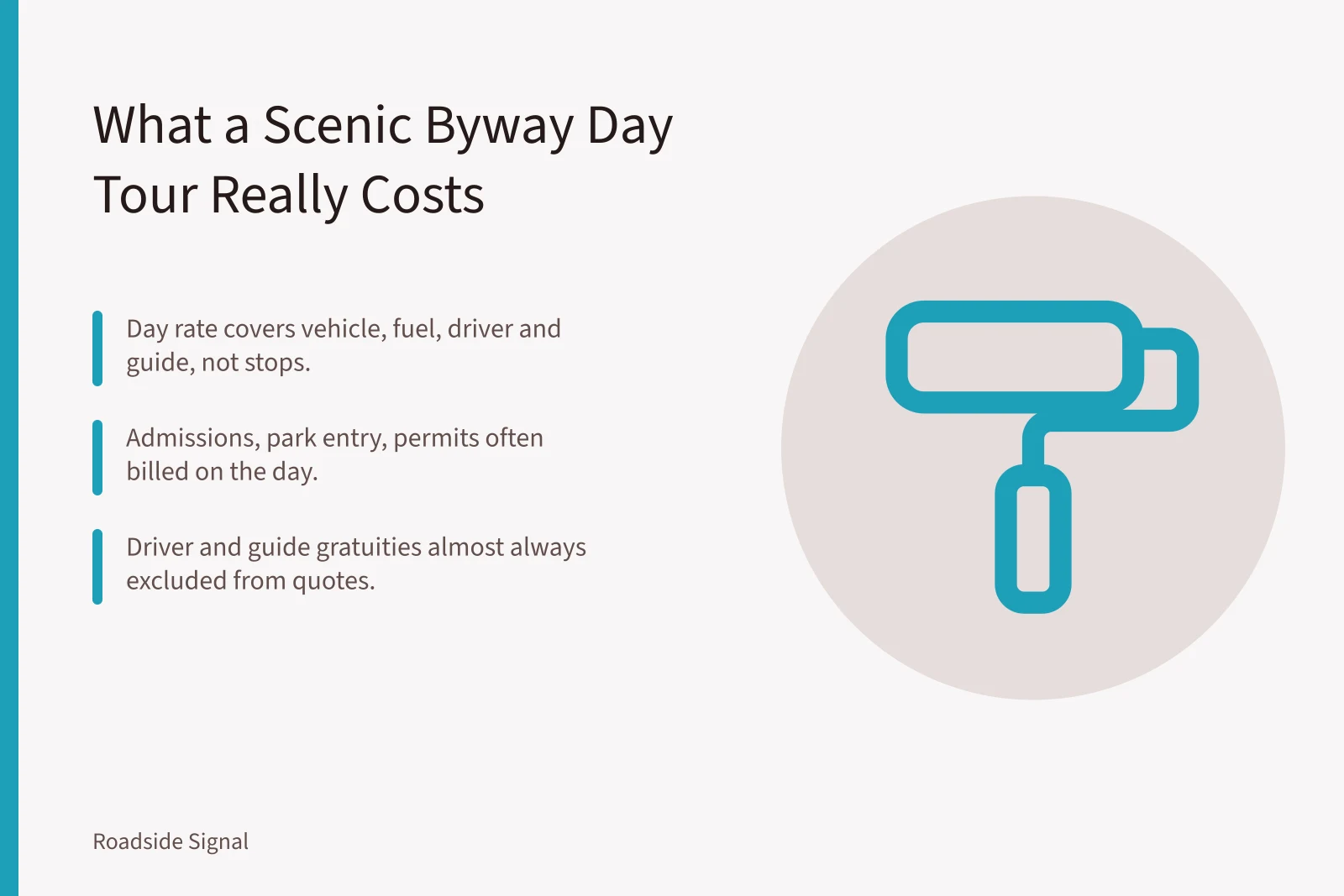
- A quoted day rate usually covers the vehicle, the driver and the guide, not the stops.
- Attraction admissions, park entry, permits and timed reservations are the items most often billed on the day.
- Gratuities for the driver and guide sit outside almost every quote and add real money per passenger.
- Ask for a written inclusions list plus a per person cash estimate before you compare two prices.
What the day rate is actually paying for
A guided byway day is priced around hours and seats, not around attractions. The operator charges for a vehicle, fuel, commercial insurance and a driver or guide's paid day. That money is spent before the first viewpoint.
Because the base price is built on labour and distance, a longer route with more stops can cost the same as a short one. What moves the number is how many passengers share the cost and how large a vehicle is needed.
Many day tours follow routes listed in the byways program, which is where official byway designations come from.
Many operators also set a minimum passenger count. If a departure does not fill, a small group may pay a private tour premium instead.
Why the route signs matter to your quote
Byway markers are public infrastructure, not a private service you are buying. Standard sign designs, including brown recreational signs, are described in the Manual on Uniform Traffic Control Devices.
That matters for value. A route that is already signed and mapped means a guide sells interpretation, timing and parking logistics rather than exclusive access.
Line items that usually sit inside the quote
Line items inside the quote
- Vehicle, fuel, planned-route tolls and driver hours.
- A guide or driver-guide for the scheduled day.
- Commercial passenger insurance and depot preparation.
- Bottled water, route maps and a printed itinerary.
- Season permits the operator holds, spread across every departure.
Line items that usually get billed on the day
Billed on the day
| Line item | Common status | Who collects it |
|---|---|---|
| Attraction admission | Usually excluded | The attraction |
| National park or state park entry | Usually excluded | The agency |
| Timed entry reservation | Sometimes included | Operator or agency |
| Driver and guide gratuity | Almost always excluded | The guest |
| Meals and snacks | Excluded | The vendor |
| Extra parking or shuttle | Varies | The operator |
This is where two quotes that look equal stop being equal. A low day rate with six paid admissions can cost more than a higher rate that bundles them.
Multi-day trips price beds and access in different buckets, so a single day figure does not scale up. The guided road trip cost breakdown walks through transport, stays and tickets one at a time.
Example: a day on the Turquoise Trail
The Turquoise Trail runs between Albuquerque and Santa Fe through Madrid and Cerrillos, and it carries a National Scenic Byway designation.
A tour along it may include transport and a guide while leaving museum entry, gallery stops and lunch to you. Ask the operator to name each stop and say whether the ticket is included or paid at the door.
Small historic districts rarely have coach parking, so lot fees can appear as a separate charge on the day.
Permits, reservations and step-on guides
Some sites require commercial vehicle permits or advance reservations. Operators often hold them, yet price them separately because the agency charges per vehicle or per departure.
A step-on guide is a local expert who boards your vehicle for part of the route. That fee is sometimes quoted as an extra and sometimes folded into the day rate.
A short checklist before you accept a quote
Before you accept a quote
- Ask which admissions are included, by name.
- Ask whether park entry and parking sit inside the price.
- Ask about the tipping custom and a per person figure.
- Ask what happens if a scheduled stop closes for weather.
A quote that lists inclusions and exclusions in writing is easier to compare than one that gives only a total.