Costs
Part of Getting road trip tour companies right the first time in 2027
5 things nobody tells you about guided road trip costs
Where the money goes on a guided road trip, what the day rate really covers, and how multi-day and single-day trips price transport, beds and access.
What to take away
- A day rate is a bundle. Ask what is inside it before comparing two of them.
- Multi-day trips carry costs a self-drive does notstaff time, permits, logistics and shuttle vehicles.
- Access fees are usually the smallest part, which is why operators rarely itemize them.
- The real comparison is the remainder over a self-drive baseline, not the headline price.
Guided road trips are priced as a package because the operator carries costs you would not. Understanding which costs those are makes it obvious whether a quote is reasonable.
What a day rate actually contains
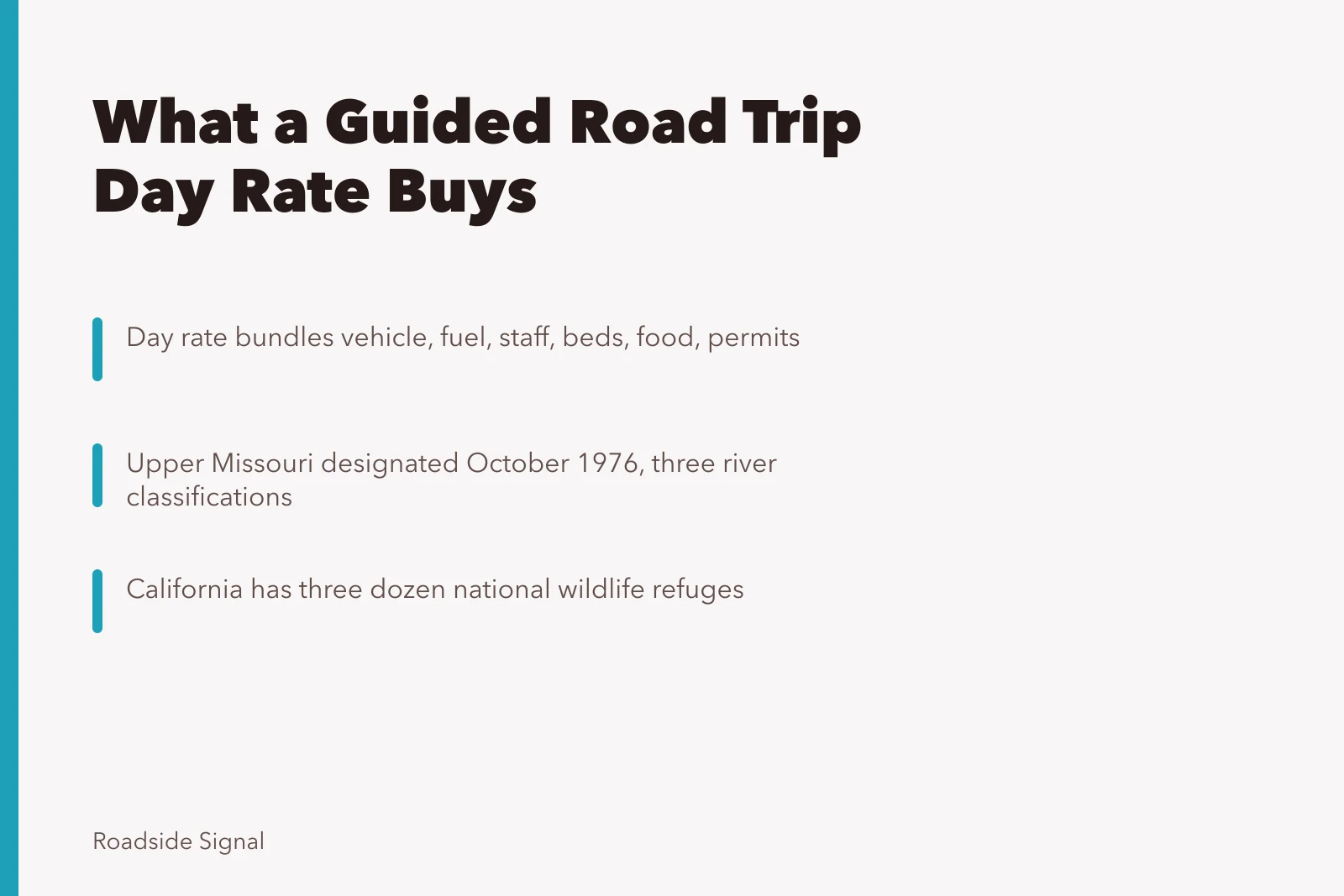
Broadly, five things: the vehicle and fuel, staff time, accommodation, food, and access fees and permits. The proportions vary enormously. A road-based trip staying in motels is mostly beds and staff. A river or backcountry trip is mostly logistics, equipment and permits, and the vehicle may be the smallest line on the sheet.
What a day rate covers
- Vehicle and fuel
- Staff time
- Accommodation
- Food
- Access fees and permits
Ask the operator to split the price across those five, even approximately. An operator who cannot is either new or hiding something.
Multi-day trips carry real logistics
Extended trips need shuttles, resupply, staff lodging, and permits that scale with party size. Long river corridors are the clearest case.
The BLM says the Upper Missouri in Montana was designated in October 1976. It contains segments of all three classifications set out in the Wild and Scenic Rivers Act of 1968: Wild, Scenic, and Recreational stretches. Each classification has different management, affecting what an operator must arrange and how much of it can be sold.
Where the trip runs changes the price
Density matters more than distance. A route that passes several sites in one day costs less per stop than one that drives four hours between them. California illustrates density: the Fish and Wildlife Service manages three dozen national wildlife refuges in the state, including one minutes from major technology campuses in the Bay Area with thirty miles of walking trails.
A trip in dense country can offer more without driving further, which is why regional operators often beat national ones on value.
Access fees are small, and that is the point
Site fees on public land are usually a minor line. That is why operators bundle them and why you should still ask which are included. The exposure is not the amount but the surprise: a per-vehicle charge, a permit collected at a gate, a state license for an activity the operator assumed you already held.
Ask for the list of anything payable on the day, in writing, and whether it is per person or per vehicle. On a shared trip the distinction can double a small number, and nobody raises it until everyone is standing at a booth.
Compare the remainder, not the total
Price the same route as a self-drive using fuel, beds, food and fees, then subtract that from the quote. Judge the remainder against the vehicle, guiding, permits and the risk the operator carries. That is the only comparison that means anything, and how to compare road trip tours on a budget sets it out in more detail.
Compare the remainder
- Price the same route as a self-drive
- Add fuel, beds, food and fees
- Subtract that from the quote
- Judge the remainder against vehicle, guiding, permits, risk
Before that, run the operator through fifteen checks to run before booking.