Guides
How to document a roadside sign: sources, versions and photo credits
Roadside sign documentation: how to build a source file for one marker or attraction, with evidence, credits, version notes and a clean handoff.
What to take away
- One sign or marker gets one fileidentifier, location, installing body, and the record behind each published line.
- Evidence, interpretation, visitor input and decision stay in separate columns.
- Old versions and set-aside ideas stay in the file with a short status note.
- Photo credits, permissions and sponsor relationships sit beside the sentence they affect.
- A handoff sheet names the open question, the gaps and the next review date.
Start one source file per sign or marker
A sign file starts with the panel itself: its text, the route, the nearest town, and the body that installed it. That body may be a state DOT, a county, a tribe, or the Federal Highway Administration through the National Scenic Byways Program.
Shield colors and shapes are their own language, and how to read a scenic byway route marker covers the common styles before you call a panel a byway marker.
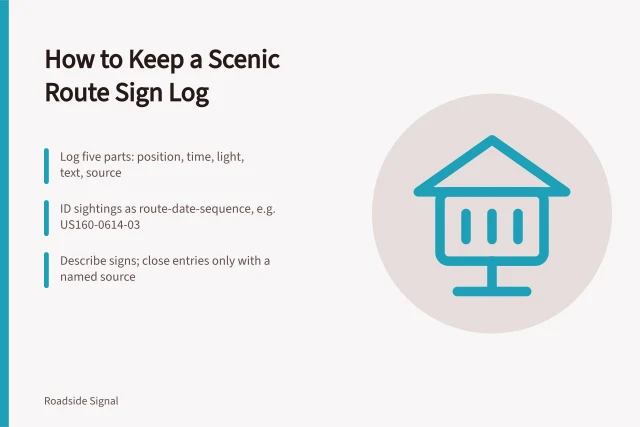
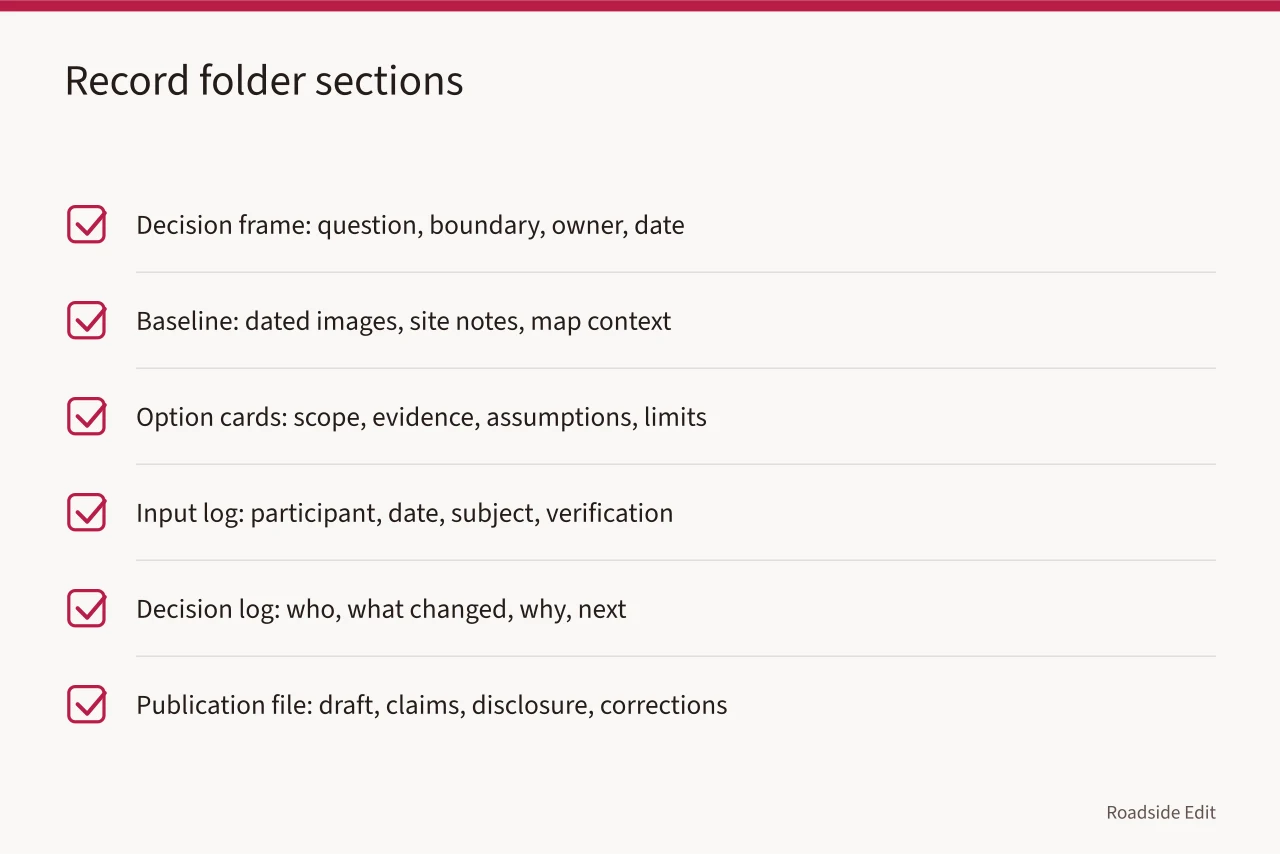
Six sections keep a file usable:
- Baseline images
- your dated photographs of the panel and the setting.
- Agency records
- designation letters, byway nominations, sign inventories.
- Site notes
- what you saw, the date, your direction of travel.
- Attribution records
- plaque text, dedication lines, sponsor names.
- Credit notes
- file name, source page, creator, license, removal contact.
- Draft copy
- the sentence you plan to publish and its record.
Keep the sections apart so a caption never reads as proof.
Separate evidence, interpretation, input and decision
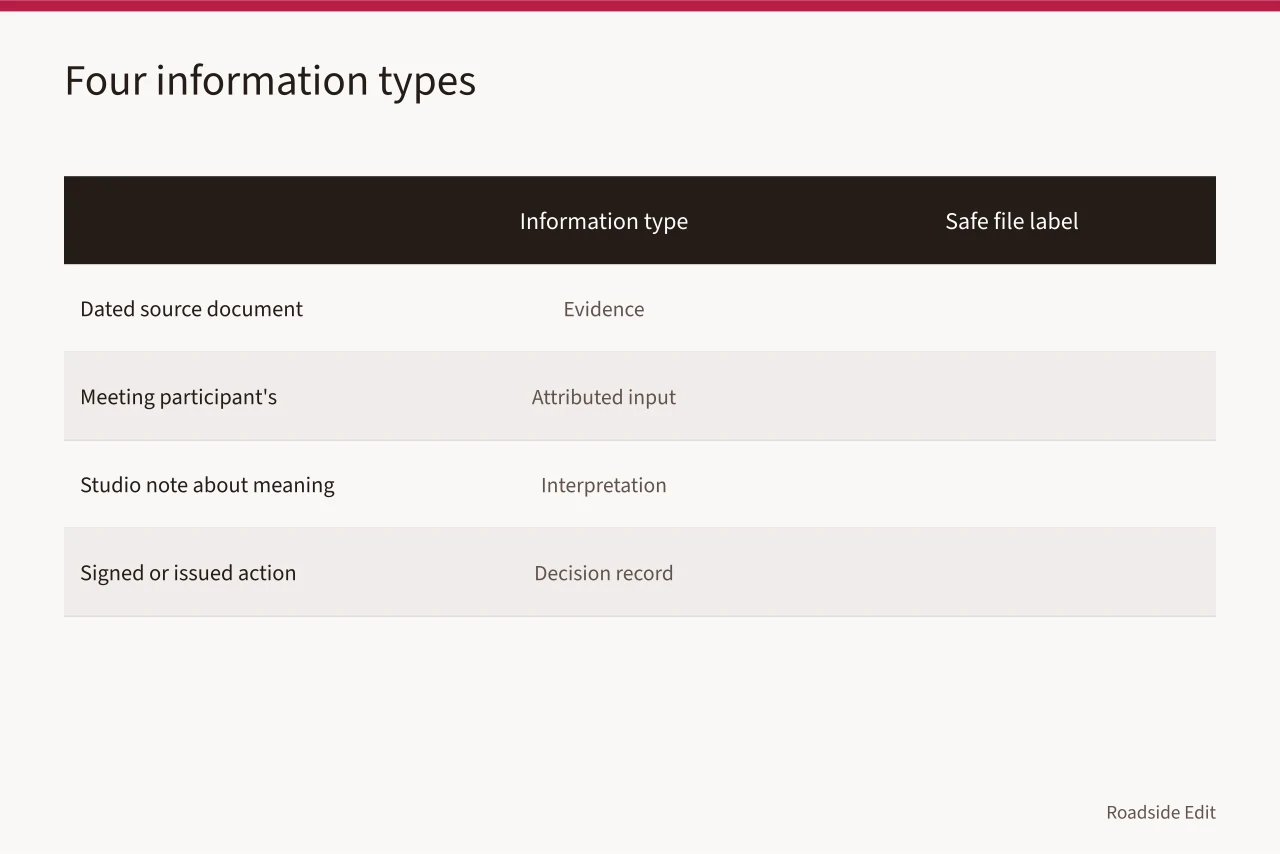
Four labels cover almost everything in a sign file. A dated photograph is evidence, and a guess about the installation year is interpretation. A shop owner's memory is input, and a designation letter is a decision record.
| Label | What it is | Sign-file example |
|---|---|---|
| Evidence | A record you can point to | A dated photograph of the panel |
| Interpretation | An explanation of what the record means | "The lettering looks 1950s" |
| Input | A stated view from a person | "My grandfather repainted it" |
| Decision | An action by the authorized owner | A designation letter from the program |
Two columns are enough: the label, and the record that justifies it. A quote and a fact should not sit in one paragraph.
Example: a green county sign in Colorado
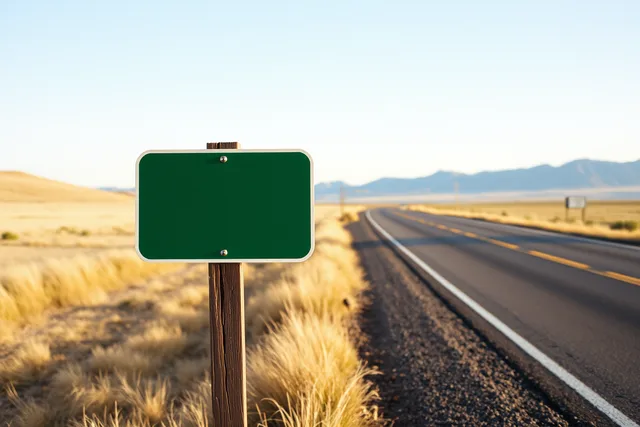
You photograph a small green sign on a county road in Colorado. The panel carries a route number, not a slogan. Before you call it a scenic byway marker, check the small green signs on Colorado backroads against what the file already holds.
If no agency record matches that route, narrow the sentence. The sign marks a county road, which is a source limit, not a failure.
Keep the evidence trail with the identification
Every identification points back to a record: a dated photograph, an issued document, a plaque transcription, or a direct observation. Put the limit beside the conclusion. A photograph proves the panel existed that day, not that anyone approved the wording.
A claim ledger needs six fields:
- Draft sentence.
- Source file or link.
- Source date.
- Source limit.
- Editorial decision.
- Review date.
The Federal Highway Administration asks analysts to document results, alternatives and any changes from the analysis plan. That guidance was written for transportation studies, not travel writing, but the habit carries.
For a real traffic sign, the Manual on Uniform Traffic Control Devices is the place to check before you describe what the panel tells a driver.
Preserve version changes and non-selections
Panels get replaced, repainted or removed, and the story changes with them. Keep the earlier photograph and note what changed. On the Turquoise Trail roadside signs route, older panels sit beside newer markers, and each pair tells a longer story.
Add a version note with five lines: what changed, the date you saw it, the older record, any stated reason, and a recheck date.
Make credits and sponsorship records part of the file
Every image and map needs its own note: file name, source page, creator, retrieval date. Add the license, the caption and a removal contact.
Commercial relationships get a separate note. If an operator paid for a listing, supplied a photograph, or hosted your visit, record the relationship and the disclosure you used. The Federal Trade Commission treats a material connection as something to disclose clearly when readers would not expect it.
New Mexico's Turquoise Trail runs official byway markers and commercial signs side by side, and the mix is easy to misread. A paid stop is still a paid stop, and neon sign restoration tour costs shows what a fee can cover on Route 66.
Prepare the handoff sheet
Before another editor receives the file, add a one-page sheet: the open question, the panel status, the key sources, the unresolved points, and the next owner for each task.
If the next editor needs paper maps, many state welcome centers still stock them, and state welcome center scenic maps covers which racks are worth the stop. If a later source conflicts with published wording, compare the sentence to the new record, revise or remove the claim, and keep the old version in a log.
Common questions
Should a set-aside identification stay in the file?
Yes. Keep it with a short status note so an old guess cannot return without its reason.
Can a plaque photo serve as the decision record?
Only when it identifies the installing body and the date. Otherwise treat it as evidence and say what it does not prove.
What should I check first in a handoff?
The open question and the panel status. They show whether the next person is reviewing a hunch or a documented identification.