Guides
Part of Getting road trip tour companies right the first time in 2027
Ask what is supplied before packing for road trip tour companies trips
Packing for a guided road trip: what operators supply, what they assume you bring, luggage limits, and the kit that makes a shared vehicle bearable.
What to take away
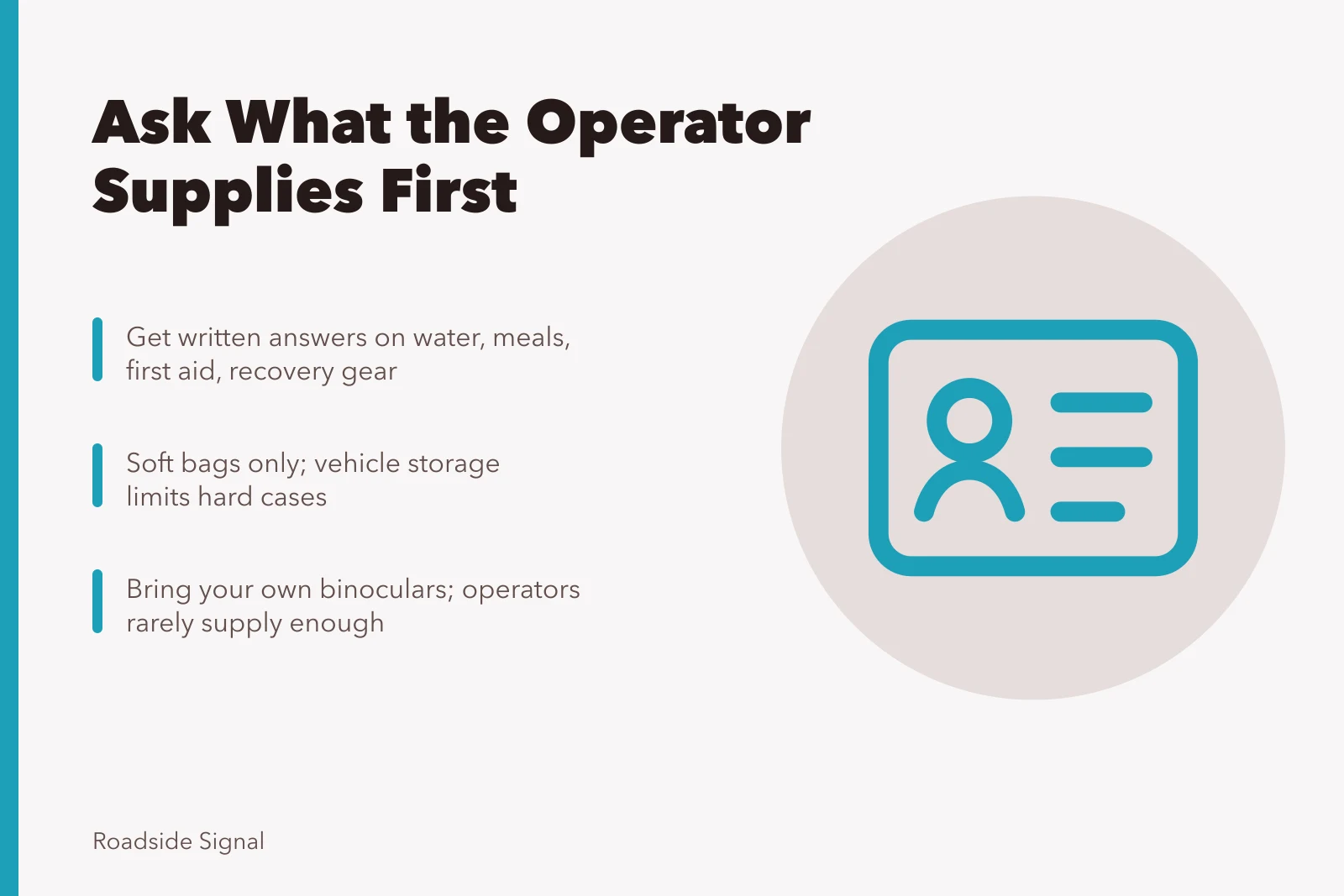
- Ask what the operator supplies before packing anything. The lists differ enormously.
- Bring your own optics. Almost no operator provides enough binoculars for everyone.
- Soft bags, not hard cases. Vehicle storage is the constraint nobody warns you about.
- Assume some stops have no facilities at all, even on a guided trip.
Packing for a guided trip is mostly a question of division of labor. The operator has already decided what they carry, and their list is rarely written down in full. Ask for it, then pack the gaps.
Ask what is supplied, in specifics
Get a written answer on water, meals, first aid, recovery gear, camp equipment, and whether the vehicle has a fridge or cooler. Ask about luggage: how many bags, what size, whether hard cases fit. Ask whether there is secure storage while you are away from the vehicle, and whether you can leave anything behind at the base.
Ask the operator in writing
- Water, meals, first aid supplied?
- Recovery gear and camp equipment included?
- Vehicle fridge or cooler?
- Luggagehow many bags, what size?
- Do hard cases fit?
- Secure storage away from vehicle?
- Can you leave items at base?
- What do guests wish they brought?
Then ask the question people forget: what do most guests wish they had brought?
Optics and identification, which are usually yours
Guided wildlife trips assume you bring your own way of seeing. The Fish and Wildlife Service's introduction to birding lists the basics for getting started.
It notes birding works at every level, from casual walkers upward, during events such as spring migration when upwards of three billion birds move north. A cheap pair of binoculars you actually carry is worth more than an expensive pair left in the vehicle.
Add a small field guide or an offline app, and a notebook. Guides answer far better questions from people who wrote the first one down.
Facilities: assume nothing at the stops
Guided does not mean serviced. Many good stops have no water, no toilets, no shelter.
The BLM page for the Cathedral Valley Scenic Backway in Utah is typical: single-lane road with a dirt base where high clearance vehicles are recommended, with few developed facilities and none on BLM-administered land.
It notes a National Park Service backcountry campground with a vault toilet nearby. Carry your own water and sun cover no matter what the itinerary promises.
The shared-vehicle kit
- A soft day bag that fits under a seat.
- Layers, because vehicle climate control is a compromise between strangers.
- Earplugs and a sleep mask for long transfers.
- A power bank, since charging points are shared and few.
- Motion sickness remedies if gravel switchbacks are on the itinerary.
- A refillable bottle, filled at every opportunity.
What to leave at home
Hard-shell suitcases, valuables you would not leave in a vehicle, and any bag you cannot lift into a roof rack yourself. Also leave the ambition to bring everything: on a guided trip you are packing for a vehicle you do not control, and space is the constraint.
Anything at the bottom of a bag in the back is effectively at home anyway. Decide in advance which items have to be within reach, and pack the rest as if you will not see them until the end of the day.
Check what the operator has actually committed to using the list in fifteen checks to run before booking, and match your kit to the traveling month with best seasons to book a guided road trip.