Costs
What does a US roadside photography trip cost in fees and tax?
Roadside photography trip costs stack up from national park entrance fees, state park day fees, BLM passes, film permits and sales tax on gear.
What to take away
- Roadside photography trip costs in the United States come from five main buckets: national park entrance fees, state park day fees, BLM recreation passes, film permits and state sales tax on gear bought en route.
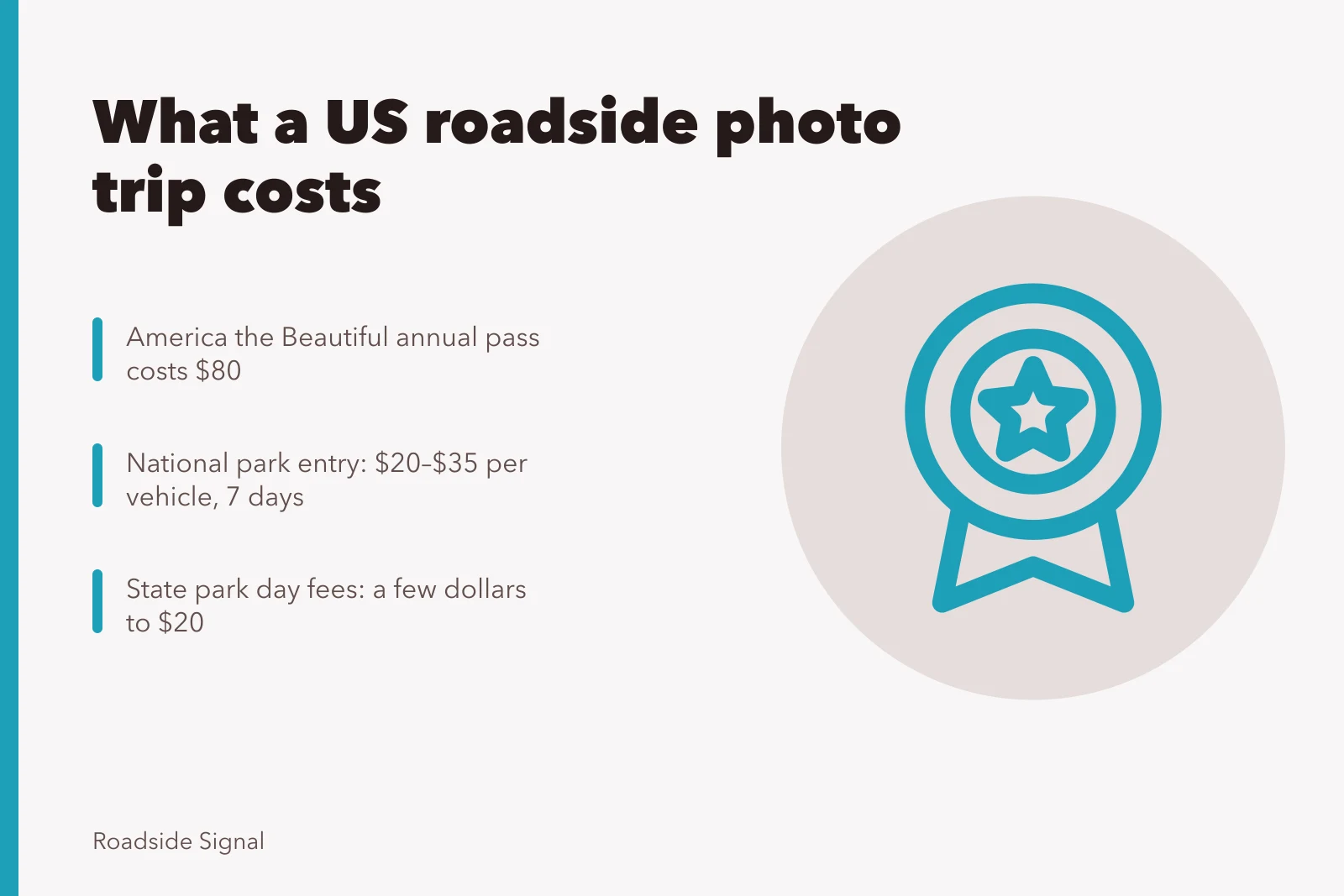
- The America the Beautiful annual pass costs $80 and pays for itself at roughly three to four large national parks, so it is the first line item to settle.
- State park day fees run a few dollars to about $20 per vehicle, and they vary by state, so a five state route can add real money.
- Film permits are the wild cardmany national parks and BLM districts charge nothing for casual roadside shooting, while commercial and drone work can trigger fees and applications.
- Sales tax on gear follows the seller's state, and some states have no sales tax at all, which changes where you buy.
- If photography is a business, IRS Publication 463 lets you deduct ordinary and necessary travel expenses, but only with records that hold up.
What a multi-state roadside shoot actually costs
A roadside photography trip across four or five states is not one cost. It is a stack of small fees, each set by a different agency, and the stack grows with every border you cross.
Fixed vs Variable Trip Costs
Fixed fees
- Charged by
- Per site or agency
- Examples
- Park, BLM, permits
- Predictability
- Published
- Planning action
- Check each site
Variable costs
- Charged by
- Seller's state
- Examples
- Fuel, lodging, gear
- Predictability
- Varies by state
- Planning action
- Track rates
Tax treatment
- Charged by
- IRS rules
- Examples
- Deductions
- Predictability
- Depends on business
- Planning action
- Keep records
Start with the fixed entries. National park entrance fees, state park day fees, BLM recreation passes and any film permits are all charged per site or per agency, not per trip. A route that touches two national parks, four state parks and a BLM backcountry byway pays each of those separately unless a pass covers it.
Then add the variable entries. Fuel, lodging, food and gear bought along the way carry state sales tax at whatever rate the seller's state charges. Those rates differ, and a few states charge none.
The last layer is tax treatment. If you shoot for clients, some of these costs become deductions, which lowers the real cost of the trip. If you shoot for yourself, they do not.
Here is the shape of it. Federal land fees are predictable and published. State fees are predictable but scattered. The permit question is the one that needs a call or a website check before you leave.
For a shorter trip, the same logic applies at smaller scale, and a road trip weekend budget breaks down the same way.
The five cost lines
| Cost line | Who charges it | Rough scale |
|---|---|---|
| National park entrance fees | National Park Service | $20 to $35 per vehicle, per park |
| America the Beautiful annual pass | USGS and federal agencies | $80 per year |
| State park day fees | State park systems | $5 to $20 per vehicle |
| BLM recreation passes | Bureau of Land Management | Varies by site, some free |
| Film permits | NPS, BLM, state agencies | Free to several hundred dollars |
| State sales tax on gear | State revenue departments | 0% to about 7% |
National park entrance fees and America the Beautiful passes
National park entrance fees are the most visible cost on a roadside photography route, and they are also the easiest to plan around. Most large parks charge per vehicle for a seven day window, and the price sits in the $20 to $35 range depending on the park.
Should You Buy the $80 Pass?
How many fee-charging federal parks will you visit?
Three or more -> Buy the $80 America the Beautiful pass
One or two -> Pay the single park entrance fee
Some parks charge per person instead, which matters if you travel alone. A per person fee can be cheaper solo and more expensive for a carload.
A handful of parks and monuments charge nothing at all. Those are worth knowing because they can anchor a cheap leg of a route.
The America the Beautiful annual pass is the standard answer to fee stacking. It costs $80 and covers entrance at federal sites that charge entrance fees, including national parks, national forests, wildlife refuges and BLM sites that participate.
Do the arithmetic before you buy. If your route touches three or more fee charging parks in a year, the pass usually wins. If it touches one, pay the single fee.
The pass does not cover everything. It does not pay for camping, parking at some concession run lots, or permits for commercial filming. Those are separate lines.
If you are building a weekend around landmarks rather than parks, the fee structure shifts, and a roadside attractions weekend budget shows how those smaller entries add up.
When the pass pays
A worked example helps. Suppose a ten day route crosses Utah, Arizona and New Mexico and enters Zion, Bryce Canyon, Grand Canyon and Carlsbad Caverns.
At typical per vehicle rates, four separate entries land somewhere near $100 to $140. The $80 pass covers all four, so the pass saves money before you reach the fourth park.
Add a fifth park and the gap widens. Add only one park and the pass is a loss unless you plan a second trip within the year.
State park day fees and BLM recreation passes
State park day fees are the quiet line item. Every state sets its own price, and the price can differ inside a single state between a flagship park and a small wayside.
Typical day use fees run from a few dollars to about $20 per vehicle. Some states charge per person. Some charge extra for a scenic overlook or a historic site inside the same park.
Annual state passes exist, but they only work if you stay inside one state. A multi state route rarely benefits.
BLM recreation passes work differently. Many BLM sites are free, and the ones that charge often accept the America the Beautiful pass. The agency's own rundown of BLM recreation passes lists what is available and which lands honor them.
The BLM also runs backcountry byways, which are a strong fit for roadside photography because they are drivable, lightly trafficked and often free. Camping along those corridors is frequently cheaper than a motel.
The agency's guide to BLM camping options and fees covers rates and rules for the corridors you are most likely to drive.
If you plan to camp on public land, read that page for the corridor you are driving. Fees there are usually a fraction of private campground rates.
Permits and fees on BLM land
Photography on BLM land is generally allowed without a permit when it is personal and low impact. Commercial work, large crews, equipment staging and drone flights can require authorization and a fee.
The agency's summary of BLM permits and fees rules sets out when a permit is needed and how the fee is set. Read it before you assume your shoot is casual.
Film permits and commercial photography fees
The permit question is where a roadside photography trip can go from cheap to complicated. The rule of thumb: personal photography from a roadside pullout is almost never permitted, and commercial photography often is.
National parks distinguish between visitors taking pictures and commercial filming. A tripod and a camera for your own use is normally fine. A client shoot, a crew, a prop setup or a drone can trigger a permit application and a fee.
Some parks charge a flat application fee. Others scale the fee to the size of the crew or the number of days. A few charge nothing but still require approval.
State agencies vary more. Some state park systems have a simple permit form and a modest fee. Others route commercial requests through a film office with insurance requirements.
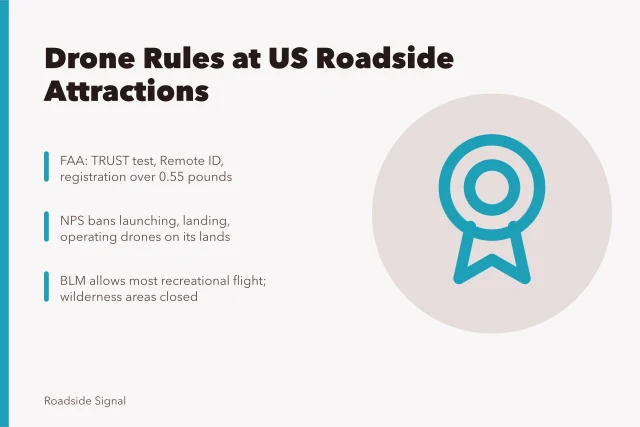
Drone use is the sharpest edge. Drones are banned in most national parks for any purpose, and rules on other federal land differ by agency and district.
The practical move is to check the specific site, not the agency in general. A permit that applies at one unit may not apply at the next one twenty miles down the road.
If your route is long, budget a permit line even if you expect it to be zero. That way a surprise application fee does not break the plan.
What triggers a permit
What Triggers a Film Permit
- Client contract
- Crew of more than one or two
- Lighting or grip equipment
- Generator or prop setup
- Drone use
If none of those apply, you are usually in the clear. If two or more apply, assume a permit is needed.
State sales tax on gear bought en route
State sales tax on gear is the cost line photographers forget, because it does not appear on a park sign. It appears at the register.
Sales Tax Varies by State
- 7%Example state sales tax rate
- 0%No-sales-tax state rate
- 8%Arizona state plus local rate
Sales tax is set by the state where the seller is located, not where you live. Buy a lens in a state with a 7 percent rate and you pay 7 percent on top of the price. Buy the same lens in a state with no sales tax and you pay nothing extra.
This creates real planning choices. If a route crosses a no tax state early, it can make sense to buy there. If it crosses one late, you may already have spent the money.
Rates also vary within states. Local jurisdictions add their own increments, so two cities in the same state can charge different totals.
Online purchases complicate it further. Many states now require remote sellers to collect tax based on the buyer's location, so ordering gear to a hotel on the road can trigger tax at that location.
Keep receipts. Sales tax paid on business gear is often deductible, and the receipt is the only proof you will have.
Gear is not the only taxed purchase. Lodging taxes are separate and usually higher, and some states add tourism taxes on top of the standard rate. Those are worth checking before you book.
A gear purchase example
Suppose you budget $2,000 for a lens and a tripod on a route through Arizona, New Mexico and Texas.
Arizona's state rate plus local additions lands around 8 percent in many cities. New Mexico's combined rate is often in the high 7s. Texas combines state and local rates that commonly land near 8 percent.
At 8 percent, $2,000 of gear carries about $160 in tax. Buy the same gear in a state with no sales tax and you keep that $160. Over a long route with several purchases, the gap is real money.
Tax treatment of photography travel expenses
If photography is a business for you, some of these costs are deductible. The controlling document is IRS Publication 463, which covers travel, gift and car expenses.
Publication 463 sets the rules for what counts as travel away from home, how long you must be away, and which expenses are ordinary and necessary. It also covers car expenses, including the standard mileage rate and the actual expense method.
For a roadside photography trip, the deductible lines typically include lodging, fuel or mileage, park and permit fees paid for the business purpose, and gear purchased for the business.
Meals are deductible at a reduced rate, and the rules on that rate have changed over time. Check the current publication rather than relying on memory.
The general tax rules for travel and photography expenses also sit in IRS Publication 17, which covers your federal income tax return more broadly and explains how business expenses flow onto the return.
The line between hobby and business matters. If the activity does not show a profit motive, deductions can be limited or disallowed. Records are what separate the two.
Records to Keep for Deductions
- Date of each expense
- Location
- Business purpose
- Mileage log
- Receipts
Records that survive scrutiny
The IRS expects contemporaneous records, meaning records made at the time, not reconstructed months later. A phone note per day is enough if it captures where you went and why.
Photographers who shoot for clients should keep the contract or assignment with the trip records. That single document ties the travel to a business purpose.
Building the total for a multi-state route
Here is how to assemble the number. Work through it in order and you will have a defensible budget rather than a guess.
Build the Multi-State Total
- List federal sites and entrance fees
- Compare total to $80 annual pass
- Add state park day fees
- Check BLM fees and pass acceptance
- Confirm commercial permit needs
- Apply sales tax to gear purchases
- Log trip and keep receipts
A four state route with two national parks, four state parks, one BLM byway and no commercial shoot can land well under $300 in fees and tax, excluding fuel and lodging. The same route with a commercial permit and a new lens can exceed $1,000.
Long byway days consume tires, brakes and oil, so roadside trip mistakes cost belongs in the budget next to the fee lines. A scenic routes trips cost breakdown shows how driving can outrun every entry fee on the route.
For the equipment side, the smarter spend is usually on position rather than glass. A road trip budgets approach to kit selection keeps the tax and gear line smaller.
Checklist before you leave
- Confirm entrance fees for every federal site on the route.
- Decide on the America the Beautiful annual pass.
- Look up day fees for every state park stop.
- Check BLM fee sites and whether the federal pass is accepted.
- Ask each land manager whether your shoot needs a film permit.
- Note sales tax rates in the states where you plan to buy gear.
- Set up a trip log for mileage, receipts and purpose.