Guides
How to keep a field log of US scenic route signs and roadside attractions
A scenic route sign log turns a drive into a record: what each marker says, who put it there, and which roadside attractions are worth the stop.
What to take away
- A scenic route sign log records what a sign said, where it stood, and which source explains it.
- Describe the sign instead of issuing a verdict about what it means.
- Give every sighting a stable ID built from route, date, and sequence.
- Keep private details out of anything you publish.
- Close an entry only when a named source identifies the sign or attraction.
You do not need a filing cabinet to read a roadside. You need a repeatable way to note what you saw and where the answer lives.
Start a sign and marker log
Use folders for route notes, sign photos, marker transcriptions, and attraction stops. Add a source list and a review date.
Byway markers follow a family of shapes and colors, and how to read a scenic byway route marker explains the bands before you log anything.
Name each file with the date, the route, and the record type. Keep the original photo and leave the post in frame.
A log entry has five parts, and each one has a minimum worth capturing.
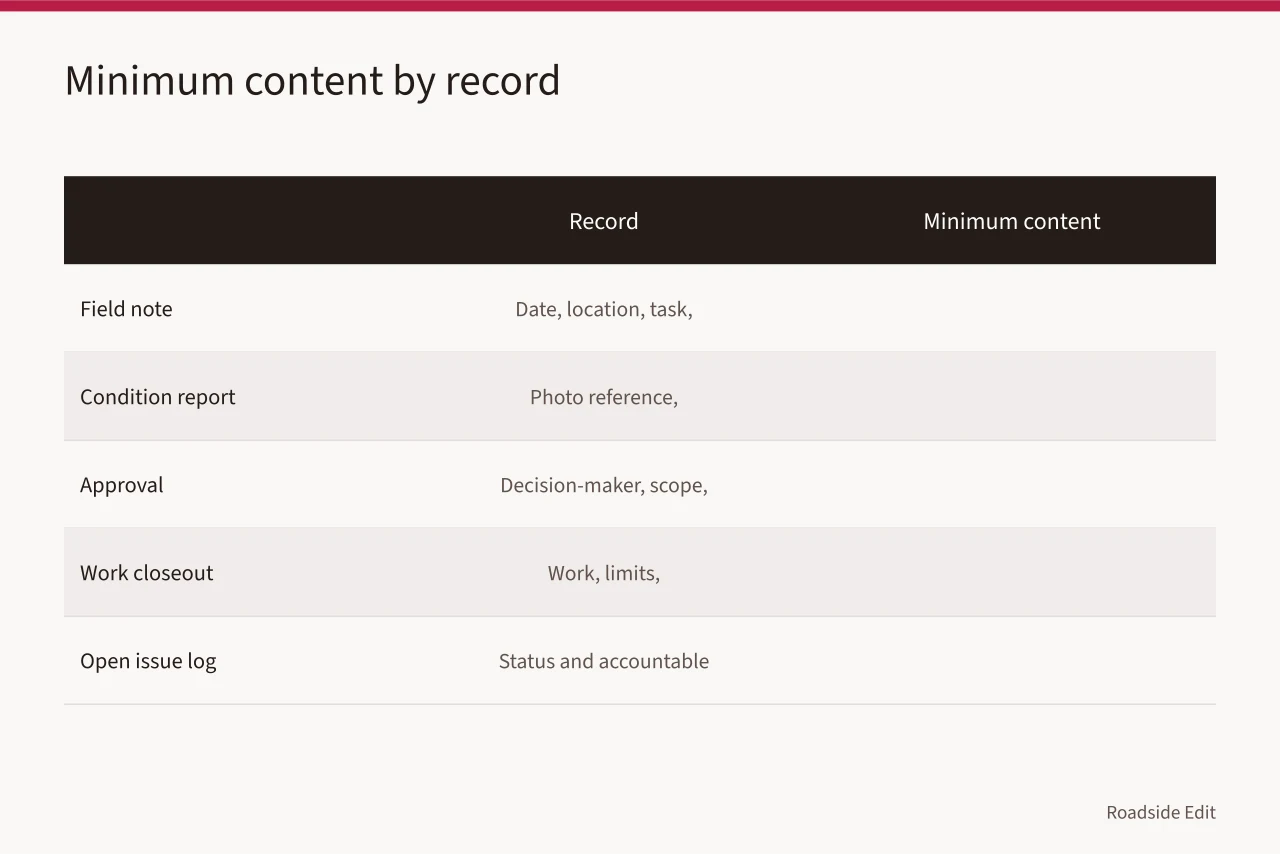
| Record | What to capture | Where it lives |
|---|---|---|
| Sign sighting | Legend, colors, post type, location | Photo folder |
| Marker transcription | Full text, spelling, any numbers | Route notes |
| Source check | Agency or page that names the sign | Source list |
| Attraction stop | Name, hours, fee, entrance sign | Trip file |
| Review date | When you last confirmed the entry | Index |
Give every marker a stable ID
Number each sighting with a route code, the date, and a sequence. A stop on US 160 on June 14 becomes US160-0614-03. Use that ID in the photo name, the note, and later messages. Two similar markers stop blurring together months later.
Before you leave the interstate, check whether state welcome centers still stock scenic byway maps for the corridor you plan to drive. Map editions change.
Write notes that describe, not judge
A field note states what you directly saw. Write the position, the time, the light, and anything that hid part of the sign.
For example, "white rectangle, green border, black text reading Turquoise Trail, on a peeled wooden post" is a description. "State-designated historic route" is a claim.
The Manual on Uniform Traffic Control Devices sets the shapes, colors, and legends US road signs use. A white rectangle with green lettering reads as a route marker, not a warning.
Example: a Turquoise Trail marker
You pull over south of Santa Fe at a wooden post sign. Photograph the panel and the post, and copy the text word for word.
The Turquoise Trail is a New Mexico byway with a mix of state and community signs. One panel rarely tells the whole route story.
Then match the entry to a route page or a state map. why the Turquoise Trail roadside signs deserve a slower drive covers the mix of markers you will pass and what each one says.
Match the panel to a route record
A single photo rarely settles a question. Keep the sighting, the transcription, the source, and the search date in one packet under the same ID.
Route histories change. A marker can outlive the designation it was made for, and a replaced panel may sit on an old post that predates the current route name.
When two sources disagree, note both and keep the entry open until one of them names the sign.
File the packet where you will find it on the next drive through the corridor.
Where to find the official answer
The National Scenic Byways Program names designated routes and describes their markers. Start there when a panel's text matches nothing you know.
Not every roadside sign is federal. Some are state routes with local habits, and what the small green signs on Colorado backroads mean shows how one state marks towns and county lines.
Protect private details
Keep plate numbers, personal contacts, and unredacted incident details out of public posts. A public photo can carry a public credit while the list behind it stays private.
Share only what a reader needs. A reader needs the legend and the location, not your itinerary or your passenger list.
Do not publish a photo just because it is scenic. Check the frame for faces, plates, and gate codes first.
Close and review the log
Close an entry when a named source identifies the sign, not when you feel sure. Add the closeout date, the source, and any detail still open. An open entry is not a failure. Some questions stay unresolved for years.
Neon raises the same issue. A restored Route 66 sign can look older than it is, and what a vintage neon sign restoration tour costs on Route 66 is a separate question from what the original letters said.
Set a review date for entries that may change.