Costs
Food is the line that surprises people in a vintage diner interiors weekend
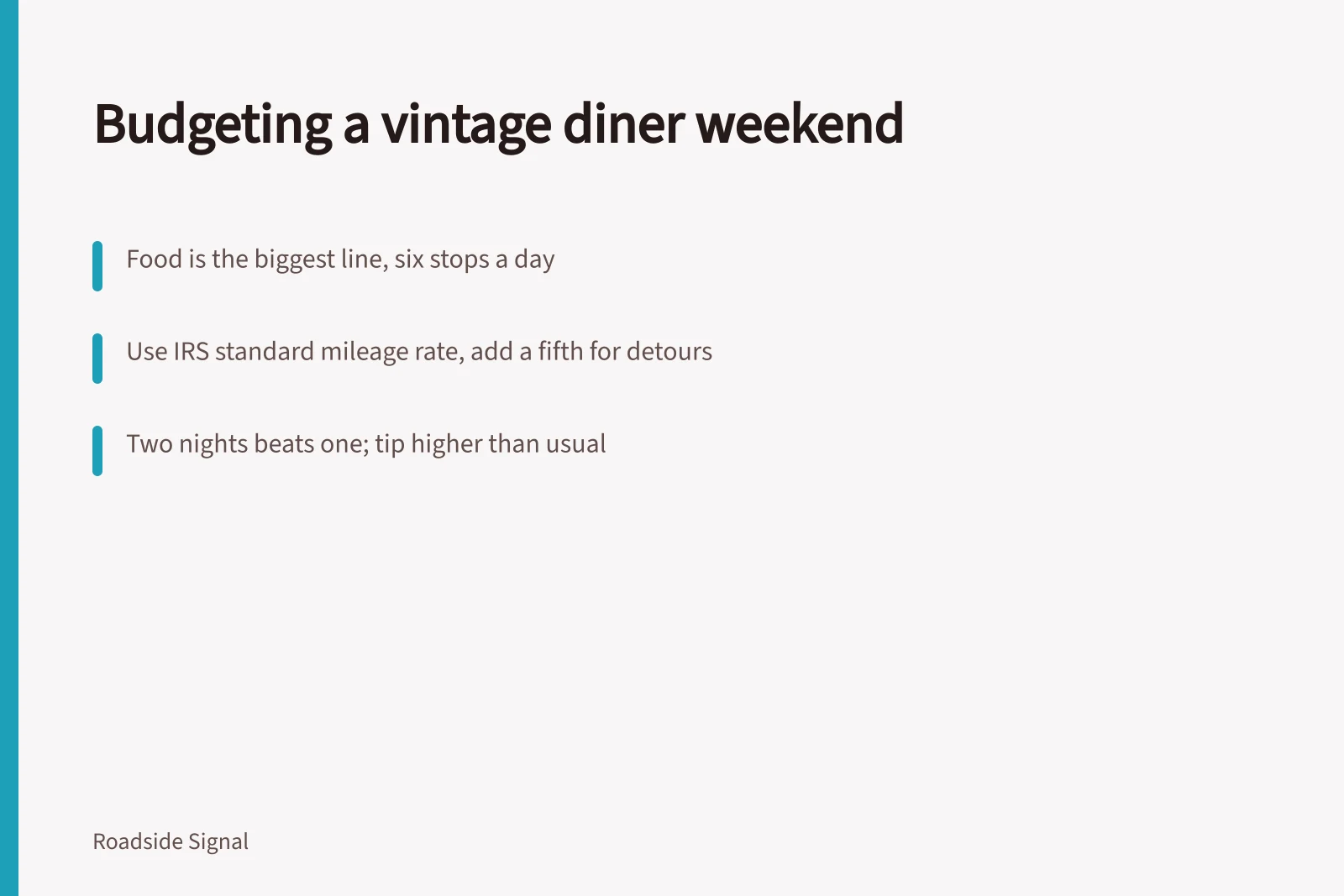
Food is the line that surprises people, because a diner weekend means buying something five or six times a day at five or six separate counters.
What to take away
- A two-person, two-night weekend with six diner stops, 250 miles and one paid tour costs about $650 low, $840 typical and $1,060 high.
- Food and tips are the biggest controllable line. Budget $180 to $310 for two people, because you buy something at every stop.
- Driving is the route plus a fifth for detours, priced at the published mileage rate. At 70 cents a mile, 300 miles is $210.
- Two nights beat one. The second night adds $95 to $180 and buys the quiet morning you came for.
- All of these are planning ranges, not quotes.
The food line, stop by stop
You eat at every stop. That is the format, and it is why food surprises people.
Not a full meal at each one. Coffee and a slice is still money, six times over, for each person.
| Stop type | Per person | Two people |
|---|---|---|
| Counter coffee and a slice | $9 to $14 | $18 to $28 |
| Short order, eggs or a sandwich | $13 to $18 | $26 to $36 |
| Full plate at a booth | $18 to $28 | $36 to $56 |
| Tip, per stop | $3 to $7 | $6 to $14 |
Six stops over two days, with one proper meal a day and small orders at the other four, lands two people between $180 and $310 once tips are counted.
Which stops, and whether a third day pays, is worked out in a shortlist built for longer trips.
The Department of Agriculture's food price outlook tracks food away from home, the category a diner weekend falls into. It will not price a specific counter, but it shows whether to plan above or below last year.
Layout changes the check. A counter stool is a short stop with a small total, while a booth held for an hour means a full plate and a tip that reflects the table. Wikipedia's article on diners covers how those formats developed.
Food budget per person
- 6stops per day
- 1proper meal a day
- 5small orders
- 1tip rate for table hour
Driving, priced with the mileage rate
Fuel alone understates the drive. The Internal Revenue Service publishes standard mileage rates that cover running costs per mile, tires and servicing included.
- Total the planned route in miles.
- Add a fifth, 20 percent, for old alignments, wrong turns and the loop back.
- Multiply by the business rate for the current tax year. Recent rates have run 65 to 70 cents a mile, so plan at 70 cents and swap in the published figure.
- Add parking. Roadside stops are usually free, downtown stops are not.
On the example weekend, 250 planned miles becomes 300 with the detour allowance. At 70 cents that is $210, well above a fuel-only guess.
The other lines that make up a roadside weekend, from lodging to tickets, are separated in the full cost breakdown.
Example: two people, two nights, 250 miles
Six diner stops, one proper meal a day, two nights on the route, 300 driving miles and one paid tour.
| Line | Low | Typical | High |
|---|---|---|---|
| Food and tips | $180 | $245 | $310 |
| Lodging, two nights | $190 | $280 | $360 |
| Driving, 300 miles | $195 | $210 | $240 |
| Paid tour, two tickets | $24 | $30 | $50 |
| Contingency, 10 percent | $59 | $77 | $96 |
| Total, two people | $648 | $842 | $1,056 |
Typical spend lands near $420 per person. The low column covers motels at $95 a night and a counter breakfast. The high column covers a better room and a full plate at every stop.
Springfield, Illinois puts several stops within a few miles, and the Cozy Dog Drive In sits on that Route 66 stretch. Short hops hold the driving line near the low column.
A half day with a local guide who knows the route sits outside the table at $100 to $250, and it pays off when two stops turn out to be closed.
The second night is the cheapest upgrade on the trip. It costs under $200 and it separates a drive from a weekend.
Where to cut and where to pay
- Book the second night in town rather than at the interstate junction.
- Eat the proper meal at lunch, when the plate usually costs less.
- Skip the gift counter and put that money into the next stop.
- Pay for a tour only if it opens a building you cannot otherwise enter.
- Hold back 10 percent for a closed stop and an unplanned detour.
The cheapest cuts are distance and appetite. A short loop holds the driving line down, and a lunch main holds the food line down.