Features
Flagstaff and Barstow neon signs worth documenting before they go
Route 66 neon signs in Flagstaff and Barstow need documenting now. Use National Register listings and SHPO surveys to record them before they go.
What to take away
- Flagstaff and Barstow neon signs worth documenting before they go are named below. In Flagstaff, start with the Museum Club, Monte Vista Hotel, Weatherford Hotel, Orpheum Theater and El Pueblo Motel.
- In Barstow, start with the Route 66 Motel, El Rancho Motel, Stardust Motel, Astro Motel and Idle Spurs Steakhouse.
- Route 66 neon in both cities is aging fast. A two-city recording method gets you organized before a sign is removed or relamped.
- Flagstaff's dense motel and cafe neon sits on city blocks and old frontage. Barstow's survivors are spread along the Mojave alignment and need a car.
- National Register listings and state historic preservation office sign surveys tell you what is already documented and what still needs your camera.
- A repeatable sequence, from pre-trip research to night exposures to archive submission, keeps your files usable by preservationists.
- The work has a deadline. Every season of desert sun and every repaint removes evidence you cannot recover later.
Why Flagstaff and Barstow reward a two-city method
Flagstaff, Arizona and Barstow, California sit at opposite ends of the same Mojave and northern Arizona Route 66 stretch. One is a high-country city with a compact historic core. The other is a desert stop where the old alignment and the interstate run side by side.
Flagstaff vs Barstow Recording
Flagstaff
- Setting
- High-country historic core
- Sign layout
- Dense walkable clusters
- Movement
- Park once, walk
- Problem type
- Urban cluster
- Logistics
- Compact, on foot
Barstow
- Setting
- Desert interstate corridor
- Sign layout
- Scattered survivors, empty blocks
- Movement
- Drive between sites
- Problem type
- Dispersed desert site
- Logistics
- Long drives, heat
The contrast is the point. In Flagstaff you can park once and walk between signs on Route 66 frontage. In Barstow you drive between scattered survivors on the old alignment, often with long empty blocks between them.
A two-city method forces you to separate two recording problems: dense urban clusters and dispersed desert sites. The skills transfer. The logistics do not, and that is what makes the pairing useful practice.
Both cities also have enough surviving neon that a single weekend is not enough. You need a research pass, a field pass and an archive pass. That structure is what you carry to other Route 66 towns later.
Flagstaff neon: Museum Club, Monte Vista, Weatherford, Orpheum and El Pueblo
Flagstaff's Route 66 corridor runs through the city's historic downtown and east along Santa Fe Avenue and Route 66 frontage. Motel and cafe signs cluster where auto courts once lined the highway.
The Museum Club at 3404 E Route 66 is a log roadhouse with a neon sign and a National Register listing. Its sign faces the highway east of downtown.
The Monte Vista Hotel at 100 N San Francisco St is a 1927 hotel with a rooftop neon sign. It sits in the downtown core, so you can record it on foot.
The Weatherford Hotel at 23 N Leroux St dates to 1900. Its corner neon sign is best shot from the sidewalk across the intersection.
The Orpheum Theater at 15 W Aspen Ave has a restored neon marquee. The marquee reads against the building, so a dusk frame catches the letters and the facade together.
The El Pueblo Motel at 2760 E Route 66 has a mid-century neon sign on the east side. The Silver Saddle Motel at 2818 E Route 66 and the Galaxy Diner at 931 W Route 66 are nearby targets with their own tube signs.
Many signs are mounted high on poles. They read against sky at dusk and against dark buildings at night. That changes your exposure strategy. Shoot both: the dusk frame shows the sign's shape, the night frame shows the tubes.
Flagstaff sits at about 7,000 feet, so summer evenings cool quickly and winter nights are genuinely cold. Neon behaves differently in cold air, and your own hands will too. Plan layers and spare batteries.
Cafe signs often hang closer to the street than motel signs, which puts them in the path of streetlights and vehicle headlights. Look for a frame where the sign's own tubes dominate and the ambient light stays behind it.
Some signs have been repainted or partially rebuilt. That is not a reason to skip them. It is a reason to note what is original and what is not, because the story is often in the story in the hardware rather than the paint.
Barstow neon: Route 66 Motel, El Rancho, Stardust, Astro and Idle Spurs
Barstow, California is a Mojave Route 66 stop where the old alignment and the modern interstate share the same corridor. Vintage motel signs and desert highway landmarks survive in pockets rather than a continuous strip.
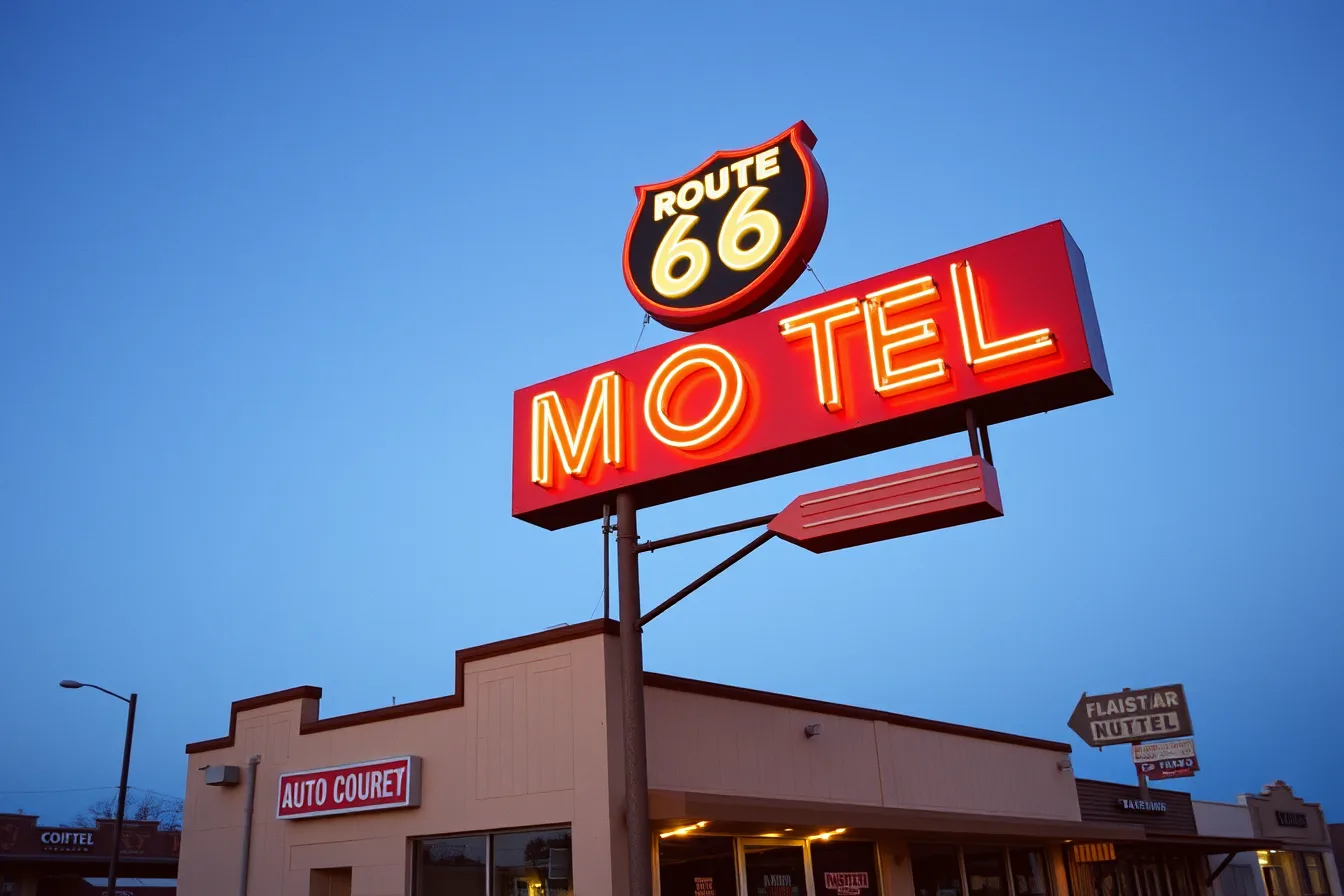
The Route 66 Motel at 1950 E Main St is a classic roadside sign on the old alignment. It faces Main Street, so a night frame from the public right of way is straightforward.
The El Rancho Motel at 1201 E Main St has a neon sign that reads against the desert sky. The Stardust Motel at 901 E Main St and the Astro Motel at 502 E Main St are other named survivors on the same stretch.
The Idle Spurs Steakhouse at 6909 E Main St is farther east. Its sign is a landmark on the route, and the parking lot gives you room to frame the pole and the building together.
Barstow Station at 1611 E Main St uses train cars and a neon sign. Peggy Sue's 50's Diner at 35654 Yermo Rd in Yermo is a short drive west and has its own tube sign.
That dispersal means you scout in daylight and shoot at night. Driving the old alignment in the afternoon lets you note pole height, sightlines, obstructions and where you can legally stop after dark.
Desert light is harsh and flat at midday, and the same sun that fades paint also fades tube color. A sign that looks washed out at noon can read cleanly at dusk. Do not judge a sign from one daytime look.
Barstow's heat is the other constraint. Summer daytime temperatures make midday fieldwork impractical, so the practical window is early morning for scouting and late evening for exposures.
Some survivors sit near active businesses, and some sit near vacant lots. Treat both the same way: document the sign, the pole, the building behind it and the street context in one frame set.
If you are choosing where to base yourself for this stretch, pick the bypassed town over the highway exit, because the signs and the streets that framed them are usually still there together.
Using National Register listings as your reference
The National Register of Historic Places is the first place to check before you photograph anything. It tells you which roadside properties are already listed and what the listing says about their significance.
Is the sign already listed?
Check National Register listings first
record condition and change
your photos may be the only record
The National Register of Historic Places (U.S. National Park Service) explains how listings work and what documentation a nomination requires. Read that before you decide your photos are enough.
The Weekly List - National Register of Historic Places (U.S. National Park Service) publishes new listings as they are added. Checking it regularly is how you catch a sign or motel that has just been documented, or one that is about to be.
Use listings as a map of gaps. If a sign is already listed, your job is to record condition and change. If it is not listed, your photos and notes may be the only systematic record.
Listing status also affects what happens next. A listed property has a paper trail and a constituency. An unlisted sign often has neither, which is why documentation done before stabilization matters for the signs that are still standing.
The Museum Club in Flagstaff is listed, so your file there should show current tube condition. If a check of the National Register and SHPO files shows no listing for the Route 66 Motel or El Rancho Motel in Barstow, treat them as gap targets.
Recording signs with SHPO survey conventions
State historic preservation offices run the surveys that most roadside sign documentation feeds into. Their conventions exist so that your photos and notes can be merged with everyone else's.
The Historic Preservation (U.S. National Park Service) pages describe the state and federal preservation framework, including the role state historic preservation offices play in survey work.
If you are new to this, Learn How to be a Preservationist - Historic Preservation (U.S. National Park Service) covers the basic skills, from reading a property to writing a description that holds up.
SHPO Survey File Elements
- Location description
- Condition note
- Date
- Photographer credit
- Caption naming sign and setting
- Consistent city-street-sign-date file names
Funding is the other half of the picture. Fund a Preservation Project - Historic Preservation (U.S. National Park Service) explains how preservation projects get supported, which is useful context when you hand your files to a local group.
Keep your file naming consistent across both cities. A simple scheme with city, street, sign name and date lets a future archivist find your work without asking you what you meant.
| Field | What to record | Why it matters |
|---|---|---|
| Location | Street address, cross street, GPS point | Ties the photo to a parcel and a survey record |
| Sign type | Pole, roof, projecting, painted | Describes the mounting and its failure risks |
| Condition | Tubes intact, broken, missing, repainted | Shows change over time when compared later |
| Setting | Building use, adjacent lots, street context | Explains what the sign was made to speak to |
| Date and time | Calendar date, dusk or full night | Neon reads differently at each hour |
| Flagstaff targets | Museum Club, Monte Vista Hotel, Weatherford Hotel, Orpheum Theater, El Pueblo Motel | Names the five Flagstaff signs in the file |
| Barstow targets | Route 66 Motel, El Rancho Motel, Stardust Motel, Astro Motel, Idle Spurs Steakhouse | Names the five Barstow signs in the file |
A field sequence for photographing neon before it goes
This sequence works in both cities. Run it once in Flagstaff and once in Barstow, then reuse it on any Route 66 town with surviving neon.
Field Sequence for Neon Signs
- Build target list from listings and SHPO records
- Scout each target in daylight
- Return at dusk for shape frame
- Shoot full night tube frame
- Record condition notes in the field
- Submit files with a cover note
Before you leave for either city, run this checklist.
- Target list built from National Register and SHPO records
- Daylight scout completed for each sign
- Dusk and night positions chosen and marked
- Condition note template printed or loaded on your phone
- Spare batteries, memory cards and a lens cloth packed
- Contact name for the state historic preservation office saved
- Archive folder structure created before the first frame
- Flagstaff targets checkedMuseum Club, Monte Vista Hotel, Weatherford Hotel, Orpheum Theater, El Pueblo Motel
- Barstow targets checkedRoute 66 Motel, El Rancho Motel, Stardust Motel, Astro Motel, Idle Spurs Steakhouse
One more thing worth doing: photograph the hardware. Brackets, transformers, conduits and mounting bolts tell you how a sign was built and how close it is to failing. That detail is what a restoration crew needs, and it is often the first thing lost when a sign is removed.
If you want to see how far the work can go, look at what vintage neon sign restoration involves and what it costs before you promise anyone a restored sign. Documentation and restoration are different jobs, and the first one makes the second one possible.
A two-day vintage highway signs route through this stretch is enough to cover the core of both cities if you plan the drive between them. Keep the plan loose enough for weather, because desert wind and mountain storms both shut down night shooting.